
Told to Get Rid of Your Cat Because of Allergies? Your Litter Might Be Part of the Problem
There’s a conversation that plays out in allergists’ offices more than most people realize. A patient comes in with chronic sneezing, itchy eyes, skin flare-ups, or persistent respiratory irritation. Tests come back showing sensitivity to cat dander. The advice is to remove the cat from the home. For a lot of people — especially those who’ve had their cats for years and consider them family — that’s not a conversation they’re prepared to have.
What doesn’t always come up in that appointment is the litter. Not the cat itself, but the box sitting in the corner of the bathroom. Because clay litter dust and synthetic fragrance compounds — present in the vast majority of mainstream litters — are independent irritants that can trigger or significantly worsen allergy symptoms in both humans and cats. Switching to a genuine hypoallergenic litter for cats won’t resolve a true dander allergy, but for a meaningful number of households, it removes a compounding trigger that nobody thought to address.
The litter box as an air quality problem
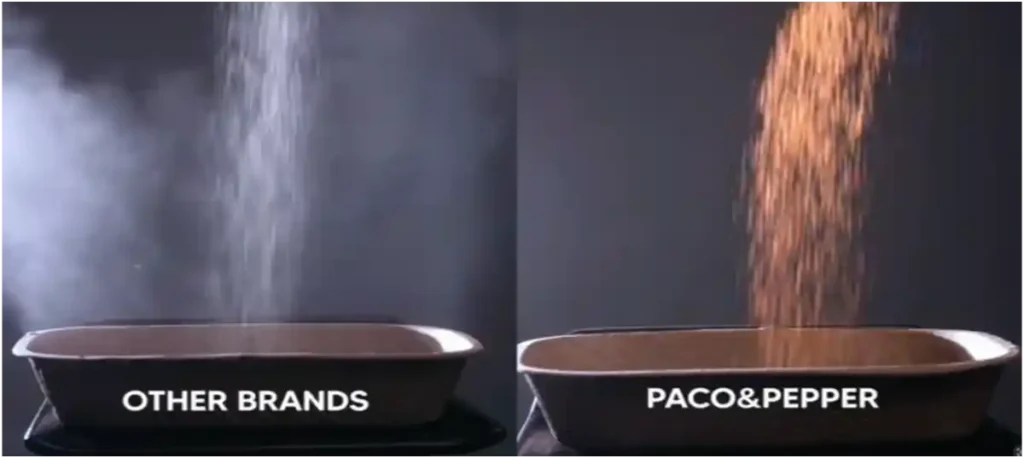
Pour a bag of standard clay litter and watch what happens. That visible cloud rising from the box isn’t steam — it’s fine silica dust, and it disperses through the room within seconds. Crystalline silica is classified as a Group 1 carcinogen by the International Agency for Research on Cancer when inhaled over time. The particles are small enough to travel deep into the bronchial system. For someone already sensitized to environmental allergens, adding silica dust into the air of a small bathroom or bedroom every day is not a neutral thing.
Fragrance is the second layer. Scented clay litters are marketed on the premise that they control odor better than unscented versions, but the reality is that synthetic fragrance compounds mask ammonia rather than neutralizing it — and those compounds are themselves significant irritants. Contact dermatitis, sneezing, and respiratory irritation from synthetic fragrance are well-documented in both humans and animals. Cats that groom after using a scented box are ingesting whatever’s coating their paws.
The combination of silica dust plus synthetic fragrance is what makes conventional litter genuinely problematic for allergy-prone households. Take both of those out and you’ve substantially changed the picture.
What “hypoallergenic” actually means for litter
The term gets applied pretty loosely in pet product marketing, so it’s worth being specific. A genuinely hypoallergenic litter has no fragrance added — not “light scent,” not “natural fragrance,” but none at all. It produces minimal or zero airborne dust during normal use. It’s made from materials that don’t carry synthetic chemical residues. And ideally it’s derived from organic or plant-based sources rather than mineral extraction.
That rules out most clay products immediately. It also eliminates a chunk of the natural litter market, which often adds fragrances or uses base materials that still generate dust in practice. Paper litter, for instance, can be surprisingly dusty despite not being mineral-based. Some corn-based litters have fragrance added to the formula.
What actually clears the bar: litters made from single organic materials with no added chemistry — things like walnut shell, wheat, wood fiber, or olive pits. These are genuinely inert from a chemical irritant standpoint, and the better ones among them perform well enough on clumping and odor that owners don’t feel like they’re making a sacrifice.
Cats get allergies too — and the symptoms are easy to miss
It’s worth pausing on the cat side of this, because it affects the choice of litter for a lot of households even when the owner doesn’t have personal allergy issues.
Cats can and do develop sensitivities to litter ingredients, and the symptoms are often misread as other conditions. Chronic sneezing that clusters around litter box use — especially after scooping or pouring — is a respiratory flag. Recurring skin irritation on the belly, groin, paw pads, and tail base points toward contact sensitivity, since those are the areas in direct contact with the litter. Over-grooming or licking of the paws after box visits can indicate either fragrance irritation or a contact reaction.
The accumulative nature of these reactions makes them harder to connect to a cause. A cat may use a litter for months before symptoms become obvious enough to notice, which makes owners less likely to think the litter is new or recently changed. It’s not always about a new product — sometimes the cat’s sensitization has simply built up over time with the same product they’ve been using for years.
Paco & Pepper — built from a cat health problem, not a market gap
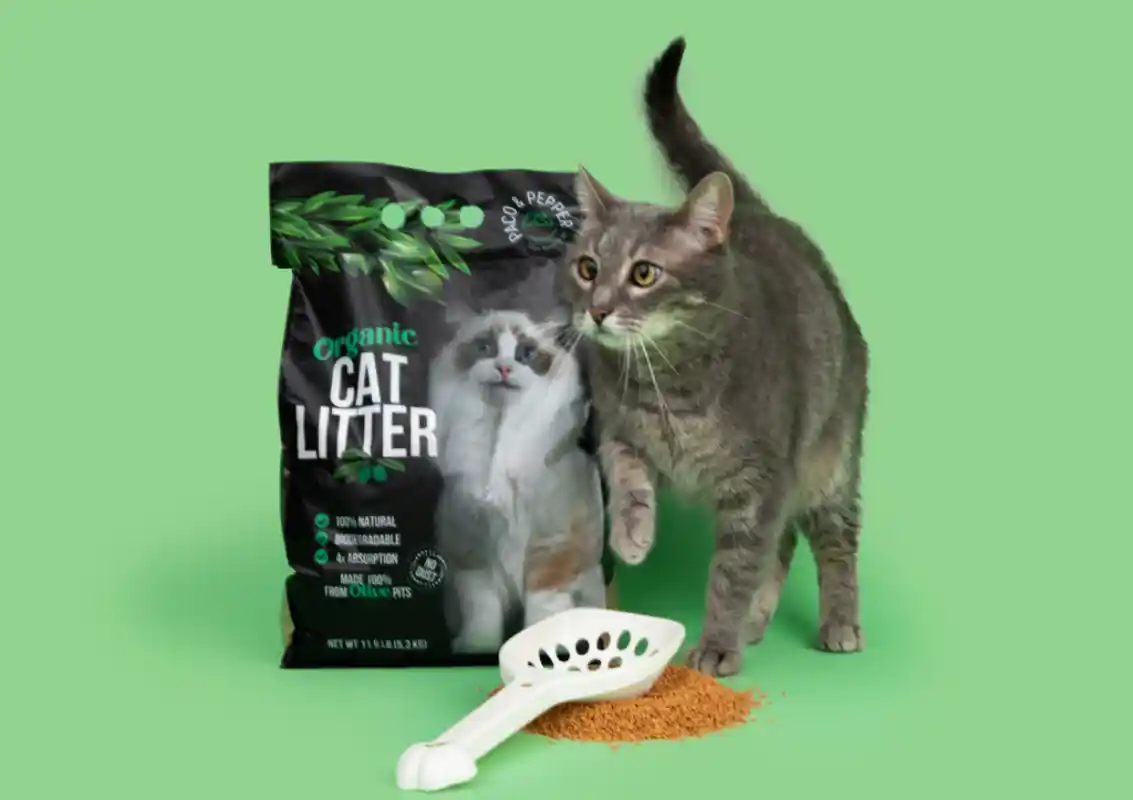
The backstory behind Paco & Pepper is relevant here. Founder Kristina Drobach didn’t set out to launch a pet brand. She had cats — Paco and Pepper — and one of them, Sonia, developed asthma. Another kept sneezing. Drobach believed the conventional litter environment was contributing and spent two years developing an alternative before launching the product in 2020.
The litter is made from crushed olive pits, a byproduct of olive oil production. Olive pit material is naturally porous, absorbs moisture efficiently, and binds ammonia inside the clump without needing any added fragrance to manage odor. The formula contains no synthetic fragrances, no harsh chemicals, and has been independently lab-tested at 0% dust — a verifiable claim, not just a label description.
There’s also a small amount of natural olive oil in the formula, which conditions paw pads during normal use. That’s a minor detail, but it matters for cats with paw sensitivity.
What happened before
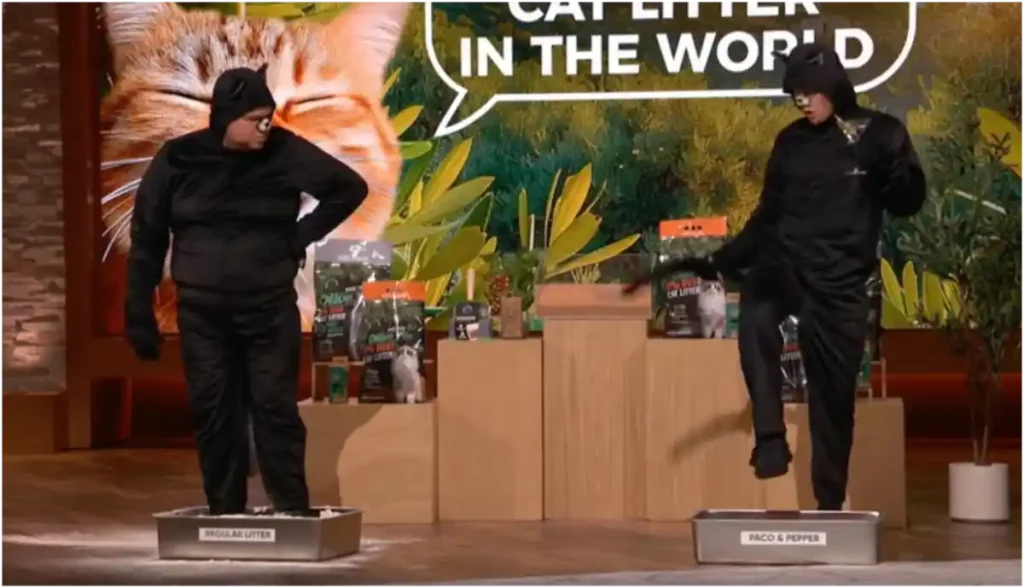
Earlier this year Drobach brought the brand to Shark Tank Season 17. She asked for $300,000 at a $6 million valuation, walked the Sharks through the numbers — $1.1 million in year-one revenue, $1.8 million already booked at time of filming — and did a live product demo that had Lori Greiner visibly impressed.
Negotiations ultimately stalled on Kevin O’Leary’s equity-plus-royalty terms and Drobach left without a deal, but the episode put the brand in front of a national audience at exactly the right growth stage. Distribution has since expanded into Target, Petco, and PetSmart alongside the brand’s own site.
Two formulas are available — classic unscented and charcoal for stronger odor environments — plus a multi-cat version with a natural malodor counteractant for households running multiple boxes. Each 11.5-pound bag is designed to last roughly a month for one cat. Review scores across more than 9,300 verified purchases hold at 4.7 stars, with consistent mentions of reduced sneezing in previously reactive cats and the total absence of that familiar grey dust cloud when pouring.
A few practical notes for allergy households specifically
If you’re switching because of human allergies in the home, keep expectations calibrated. A litter change removes a dust and fragrance irritant — it doesn’t address dander, which is a protein allergen shed from skin and coat. Running a HEPA air purifier near the litter area helps further. Grooming the cat regularly reduces dander load. These things work together rather than any single change solving the whole problem.
For cat allergies — where the animal is the one reacting — a gradual transition over one to two weeks is the standard approach. Mix the new litter in at about 20% initially and increase the ratio slowly. Cats notice texture and smell changes acutely, and an abrupt switch can result in box avoidance that creates its own complications.
More on the full product range at Paco & Pepper.