
How Voice Assistants Are Transforming the Restaurant Industry
Voice assistants are transforming the restaurant industry by integrating innovative technology into daily operations, enhancing both customer experiences and operational efficiency. Many operators are now adopting voice AI to improve order accuracy and speed, from drive-thrus to phone-in orders. Learn how industry leaders are deploying these tools and explore future trends. For a detailed look at specialized solutions in this space, visit https://www.soundhound.com/voice-ai-solutions/restaurants.
As customer expectations rise and competition intensifies, the restaurant industry must evolve. Technologies like voice assistants not only simplify service but also improve financial performance. Whether at drive-thrus, in call centers, or with online orders, voice AI is rapidly becoming a differentiator that helps brands stand out. Voice technology is also designed to make restaurants more resilient to workforce shortages, supporting existing staff and helping operators scale up during peak hours.
The adoption of AI-driven systems can also enhance brand consistency, regardless of staff turnover or training levels. Another key benefit is the technology’s role in boosting upsell opportunities and reducing order errors, leading to higher customer satisfaction and larger average ticket sizes for restaurants. This positive cycle of engagement and efficiency is driving interest among both major chains and independent operators.
Introduction
Amid ongoing labor shortages and rising wages, restaurants are exploring new ways to preserve margins while enhancing customer service. In this environment, voice AI technology has emerged as a powerful tool, automating order taking at drive-thrus and call centers. Chains like Wendy’s, Taco Bell, and Pizza Hut are at the forefront, deploying conversational agents to streamline operations, manage custom orders, and elevate upselling opportunities. These solutions prioritize rapid, consistent service across all shifts and locations, addressing customer expectations for speed and accuracy.
Moreover, voice AI systems are built to adapt and learn. As they process thousands of customer interactions daily, these systems become more adept at handling regional accents, dialects, and even complex, multi-item orders with increasing precision. This adaptability further cements voice AI as a key lever in digital transformation throughout food service, mitigating many communication challenges seen in traditional workflows.
Why Voice AI Matters for Restaurants
Restaurant operators face two persistent challenges: maintaining staff morale while delivering fast, flawless service, and growing average check sizes. Voice AI addresses both needs effectively.
- Labor efficiency: Voice AI relieves employees from routine tasks, shifting the focus to quality assurance, hospitality, and efficient food prep. This reduces burnout and helps manage labor shortages.
- Revenue growth: AI-driven ordering systems allow for consistent upselling and real-time menu optimization. Automated prompts can nudge guests toward combos or specials, and predictive analytics track ordering patterns to segment and target offers more effectively.
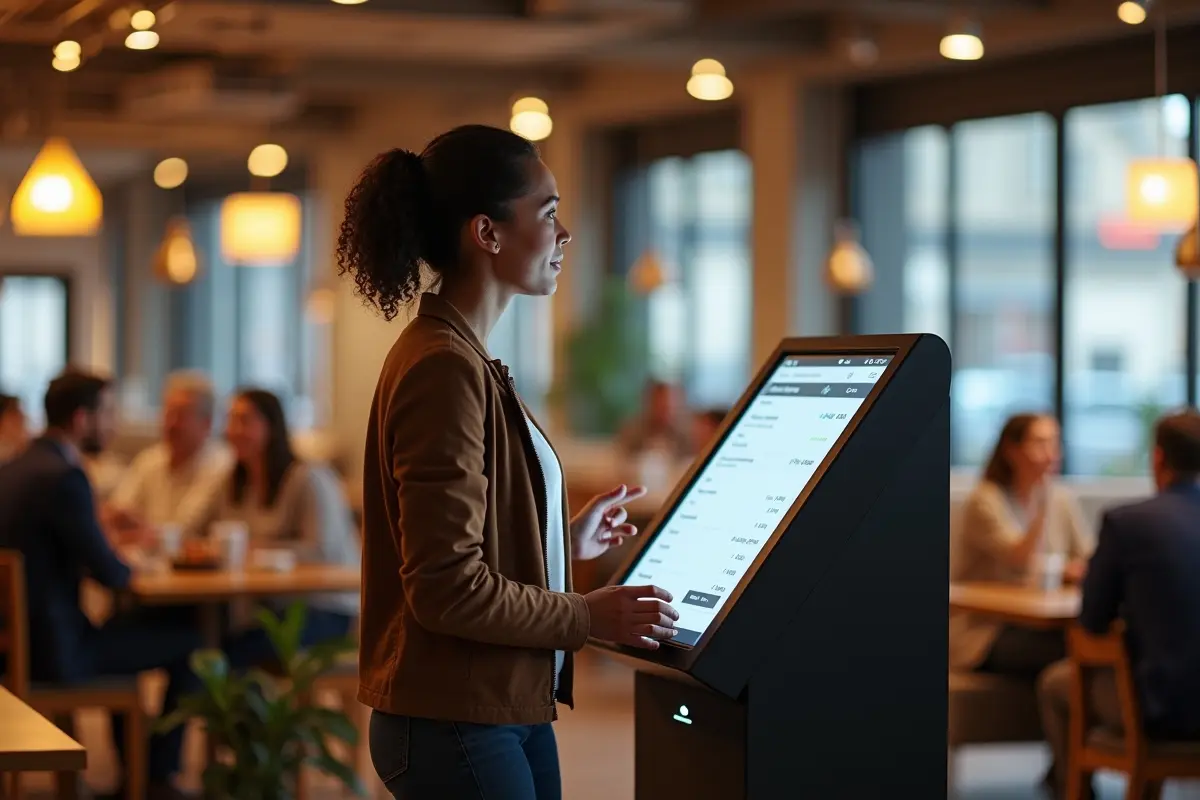
Beyond day-to-day benefits, voice AI can play an important role in accessibility. For guests with vision impairments or those who may have trouble using touchscreen kiosks, a conversational interface allows them to place orders independently. This not only broadens a restaurant’s market but also reinforces its commitment to inclusivity and customer care.
Recent Industry Momentum
- Strategic partnerships: Leading brands are making significant moves in AI. Yum! Brands, for example, have collaborated with Nvidia to roll out AI-powered ordering systems at 500 Taco Bell, Pizza Hut, and KFC locations by 2025. This partnership is designed to accelerate further the adoption of AI across the competitive quick-service segment.
- Rapid scaling: Wendy’s is scaling its FreshAI assistant throughout hundreds of drive-thrus. Initial deployments required significant training, but innovations have catapulted reported accuracy rates from 70 percent to beyond 90 percent at many sites.
- Omnichannel reach: Voice AI is not confined to a single touchpoint. The latest offerings support call-to-order, text-based transactions, and even in-car voice-activated ordering, creating a seamless experience for customers and offering new engagement channels for brands.
Additionally, some smaller operators are finding success with off-the-shelf voice AI solutions. These platforms democratize access to advanced automation, allowing independents and regional chains to compete with the resources of larger brands. By integrating with existing POS systems and providing user-friendly dashboards, these solutions streamline the adoption process and deliver value from day one.
Technical Insight: Adoption vs. Accuracy Over Time
The pace of adoption of AI-powered order-taking has surged. In 2018, major restaurant chains reported less than 10 percent usage of automated ordering. By 2024, that figure is approaching universal adoption among top performers. This increase aligns with dramatic improvements in voice recognition technology, pushing average order accuracy from around 60 percent up to more than 90 percent.
The improvements come from deeper machine learning, frequent retraining, and better integration of feedback provided by both customers and in-store staff. The increased sophistication of these systems means they are not only better at understanding orders but can proactively identify upsell opportunities in real time. Furthermore, improvements in natural language processing enable more lifelike, friendly interactions, something customers increasingly expect when engaging with any digital interface.
Best Practices for Operators
- Start small: Launch pilots in a few high-traffic locations to test and gather real-world data before a wide-scale rollout.
- Monitor and iterate: Continuous improvement is critical. Using analytics, operators should track and review instances of order inaccuracy to train systems more effectively.
- Integrate user feedback: A hybrid model that involves quick AI hand-off to a human for complex or high-value orders ensures reliability. Incident data from these cases helps AI platforms become smarter over time.
- Maintain transparency: Clear communication builds customer trust. Operators should let customers know when they are interacting with an AI-powered assistant and provide a simple way to reach a human if needed.
Operators should also consider ongoing staff training to ensure a smooth partnership between humans and AI technology. Human workers who understand the strengths and limitations of voice AI are much better equipped to support happy, loyal customers and respond quickly to unique or unexpected requests that the system might escalate.
Looking Ahead
Voice technology is now a core element in the restaurant industry’s digital toolkit, not a novelty. Operators who prioritize AI-powered automation and seamlessly integrate it into operations will deliver faster service, greater accuracy, and higher guest satisfaction. As the technology continues to mature, expect even broader adoption and new ways to delight guests, ultimately leading to stronger competitive positions and improved profitability.
Looking to the future, industry analysts predict that voice-AI integrations will extend beyond order-taking into areas such as inventory tracking, allergen management, and even real-time customer sentiment analysis. By harnessing AI-driven data insights, restaurants can respond more effectively to demand shifts, personalize offers, and maintain a high-touch experience as expectations continue to evolve.
Conclusion
Voice AI is rapidly becoming a core driver of transformation in the restaurant industry, reshaping how brands handle ordering, customer service, and operational efficiency. By improving speed, accuracy, and accessibility across drive-thrus, call centers, and digital ordering channels, these systems help restaurants meet rising customer expectations while easing staff pressure.
As adoption continues to grow and technology advances, voice AI is evolving from a competitive advantage into an industry standard. Looking ahead, restaurants that successfully integrate and optimize these tools will be better positioned to deliver consistent, scalable, and highly personalized guest experiences in an increasingly digital-first marketplace.